Read FLIS identification, sourcing and reference segments
Part of these button learning paths: Research All Open Solicitations · Just My Opportunities · Machine Shops Opportunities · Unfulfilled NSN Opportunities · Search by NSN/NIIN · APL/AEL Historical · DLA Prime Contractors · Naics To FSC Cross · Commercial Part Number to NSN · Weapons System Designator Codes
Video sections for this page
From an NSN result, FLIS Header opens Segment A, MOE Rules opens Segment B, and MCRL opens Segment C. Segment A describes the item, Segment B shows management and acquisition rules, and Segment C lists part-number references. Keep leading zeros when copying the NIIN.
How to get here and continue
- Search a stock number through Search by NSN/NIIN, then open its NSN result. Choose FLIS Header for Segment A, MOE Rules for Segment B, or MCRL for Segment C.
- The selected link opens its own segment view. Read that segment's fields below; from Segment C, compare each part number with its CAGE before treating the row as a supplier reference. Create Report on the item page is a separate route to the combined report.
- Back on each segment view returns through browser history to the page that opened it. The segment guides do not establish a visible Main Menu control.
Segment A: item identification
| Field | Meaning and use |
|---|---|
| NAME | Catalog item name. Compare it with the item you are researching; it is not a full specification. |
| INC | Item Name Code for the cataloged name. Decode a specific value with the applicable item-name reference. |
| FIIG | Federal Item Identification Guide identifier. It points to the guide used to structure an item's descriptive characteristics, not to a characteristic value by itself. Decode the specific guide before using it to infer technical properties. DLA catalog-tool comparison. |
| CCF | Catalog criticality code. Check the displayed value against the applicable FLIS reference before using it to interpret an item's requirements. |
| TOII | Type of Item Identification indicator. It describes the item's identification method; check the displayed value against the applicable FLIS reference before interpreting it. DLA catalog-tool comparison. |
| RPDMRC | Reference or Partial Descriptive Method Reason Code. It indicates why an item was identified by reference or a partial description rather than a complete descriptive method. NATO codification manual. |
| DEMIL | Demilitarization code, used to classify an item's demilitarization requirements. |
| HMIC | Hazardous Material Indicator Code. Use it as a catalog indicator and check the item's safety information for handling requirements. |
| ESD | Electrostatic-discharge/electromagnetic-interference code. |
| PMIC | Precious Metals Indicator Code. It is a classification, not a measured quantity. |
| ADP | Automated Data Processing Equipment Identification Code. |
Use Back to return from Segment A. No export is shown on this page.
Segment B: management and acquisition rules
| Field | Meaning and use |
|---|---|
| MOE Rule | Major Organizational Entity rule identifier for a service or agency management relationship. |
| DSOR | Depot Source of Repair code, identifying repair-support information. |
| AMC | Acquisition Method Code. Read it with AMSC to understand the recorded acquisition method. |
| AMSC | Acquisition Method Suffix Code. Read it with AMC for the complete acquisition-method entry. |
| NIMSC | Nonconsumable Item Material Support Code describing a support relationship. |
| IMC | Item Management Code. |
| IMCA | Item-management activity value. |
| AAC | Acquisition Advice Code describing acquisition guidance for the item. |
| Collaborators | Supplemental collaborator codes associated with the rule. |
| Receivers | Supplemental receiver codes associated with the rule. |
Use Back to return from Segment B. A displayed rule provides management context; check the current solicitation for its source-approval terms.
Segment C: reference-number list
| Field | Meaning and use |
|---|---|
| Part No. | Recorded part or reference number associated with the NIIN. Compare exact characters and punctuation. |
| RNCC | Reference Number Category Code; describes the reference category. |
| RNVC | Reference Number Variation Code; describes a variation in the reference. |
| RNFC | Reference Number Format Code; describes how the reference was formatted relative to its source document or manufacturer version. DLA data dictionary. |
| RNJC | Reference Number Justification Code. |
| RNSC | Reference Number Status Code. |
| RNAAC | Reference Number Activity Address Code, associated with possession or availability of a drawing or technical document for the reference. DLA data dictionary. |
| SADC | Service/Agency Designator Code associated with a reference record. DLA QDB glossary. |
| DAC | Document Availability Code. |
| CAGE | Commercial and Government Entity identifier associated with the reference. Read it with the part number. |
| Company Name | Stored vendor name associated with the reference. |
Use Back to return from Segment C. Several reference rows can be listed for one NIIN; read each row as a part-number and CAGE pair.
Live example: 4030-00-266-7415
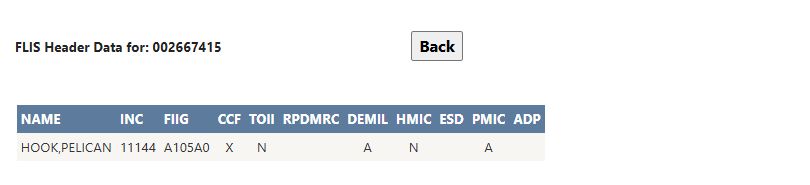
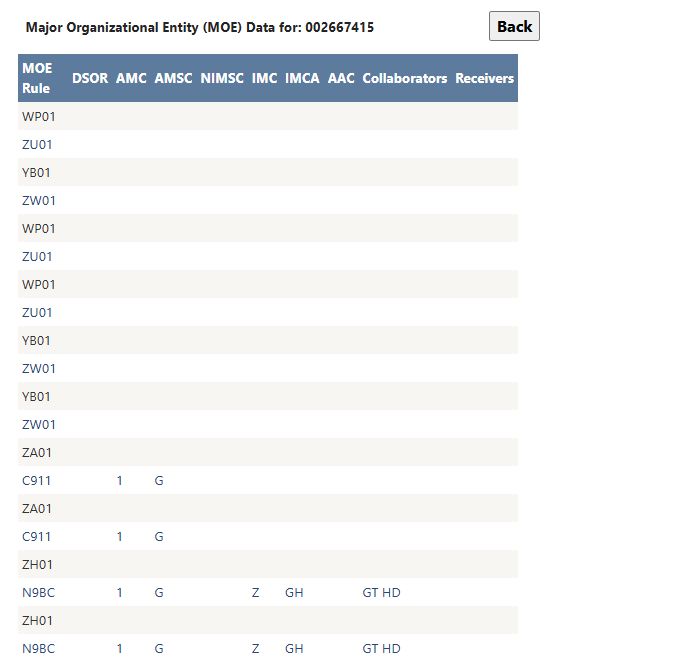
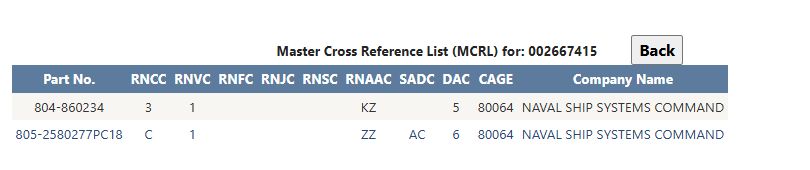
For NSN 4030-00-266-7415, Segment A showed HOOK,PELICAN, INC 11144, FIIG A105A0, CCF X, TOII N, DEMIL A, HMIC N and PMIC A; RPDMRC, ESD and ADP were blank. Segment B showed 24 rows, including repeated MOE rules. For example, C911 / AMC 1 / AMSC G and N9BC / AMC 1 / AMSC G each appeared more than once; compare the complete row. Segment C showed references 804-860234 and 805-2580277PC18, both with CAGE 80064 and company NAVAL SHIP SYSTEMS COMMAND. The first showed RNCC 3, RNVC 1, RNAAC KZ, DAC 5; the second showed RNCC C, RNVC 1, RNAAC ZZ, SADC AC, DAC 6.
Interpret selected codes in this example
Each definition applies to the named field only. The same letter can mean something different in another field.
| Displayed value | Plain-English reading and practical limit |
|---|---|
| DEMIL A | A non-munitions-list item in this code system. The code is a catalog classification; current handling and transaction requirements still depend on the item and applicable documents. DLA demilitarization-code definition. |
| HMIC N | The catalog has no Hazardous Materials Information Resource System data and the supply class is not generally suspected of hazardous material. This is not a substitute for the actual item's safety and handling information. DLA hazardous-material-indicator definition. |
| PMIC A | The catalog code says the item contains no precious metal. It is not a measured metal-content quantity. DLA precious-metals-indicator definition. |
| AMC 1 | The catalog considers the item suitable for competitive acquisition. This does not establish that a competition is currently open. DLA AMC definition. |
| AMSC G | The screening assessment found the technical data suitable and legally clear for competition. Check that the actual required data is available. DLA AMSC definition. |
| RNCC 3 on 804-860234 | A design-control reference. Read it with the variation code and drawing context before identifying an offered item. DLA reference-category definitions. |
| RNCC C on 805-2580277PC18 | An advisory cross-reference; its presence does not make it an interchangeable approved part. DLA reference-category definitions. |
| RNVC 1 on both references | More identifying information is needed; the number alone does not identify the production or supply item. DLA variation-code definition. |
| DAC 5 | A drawing represented the reference but was unavailable to the recorded activity when submitted. This is historical cataloging information, not today's download result. DLA document-availability definitions. |
| DAC 6 | Other technical documentation, rather than a drawing, was unavailable to the recorded activity at submission. DLA document-availability definitions. |
Example: qualify a proposed part
Confirm the item name in Segment A, read the AMC/AMSC and MOE rule in Segment B, then compare the Part No. and CAGE in Segment C. For more about FLIS data categories, see DLA's FLIS reading-room instructions.
Download this article as Markdown