Read FLIS shipping and management data
Part of these button learning paths: Research All Open Solicitations · Just My Opportunities · Machine Shops Opportunities · Unfulfilled NSN Opportunities · Search by NSN/NIIN · APL/AEL Historical · DLA Prime Contractors · Naics To FSC Cross · Commercial Part Number to NSN · Weapons System Designator Codes
Video sections for this page
Application path: Main Menu → Search by NSN/NIIN → enter the number → Search.
Use this search when you have a stock number and want its identity, technical details, reference parts or buying history. Enter the full 13-digit NSN or its 9-digit NIIN. Keep leading zeros.
Shipping
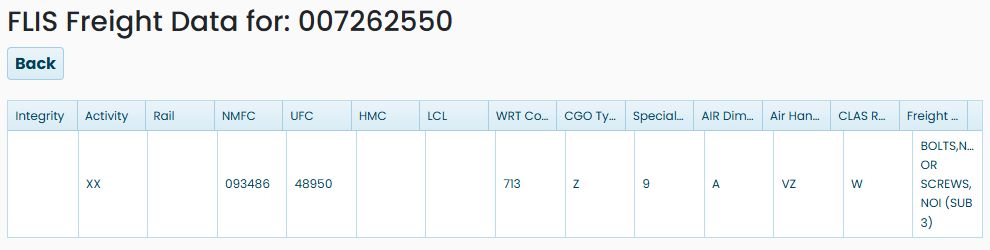
Choose Shipping to view freight and handling classification information recorded for the item. The example displays one row with abbreviated headings and the description BOLTS, NUTS OR SCREWS. Read each value with its column heading; the short code values are not expanded here.
ML-C
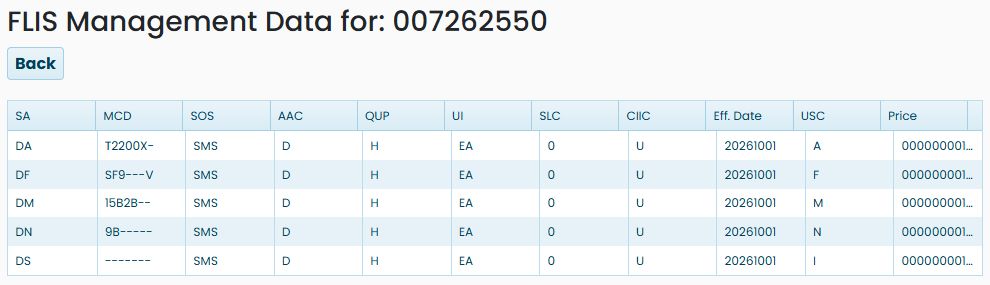
Choose ML-C to review the item's management-list entries. The cap-screw example shows five rows. Read each row using its headings; the same field can vary across rows, so keep the values together. These plain-language descriptions explain each field's role without decoding its displayed code.
| Field | What it describes |
|---|---|
| MCD | Management Control Data recorded for the row. Its positions can carry different service-specific values. |
| SOS | Source of Supply field used in supply routing; it does not show current stock or promise availability. |
| AAC | Acquisition Advice Code field. Check an approved code reference before interpreting its value. |
| QUP | Quantity per Unit Pack field. Check the applicable definition before using it to compare pack quantities. |
| UI | Unit of Issue field. Read it when comparing quantities or prices. |
| SLC | Shelf Life Code field. Do not infer a specific shelf-life rule from an unexplained value. |
| CIIC | Controlled Inventory Item Code field. Read the value with its approved definition. |
| Eff. Date | Effective-date value recorded with the management row. |
| USC | Using Service Code field. Read the value with its approved definition. |
| Price | Stored management-list price; it is not a current award or supplier quote. |
Shipping and quoting example
When checking an item for a quote, read the shipping fields together with the management row. Unit of Issue and Quantity per Unit Pack help distinguish an each price from a pack price. Check the displayed code against its approved definition, then compare the current solicitation packaging and delivery instructions. Use Back to return to the item page and choose the next research view.
Segment G: shipping-data fields
| Screen label | Stored value and why a user checks it |
|---|---|
| Integrity | Freight-integrity code stored with the freight data. DLA approved process summary. |
| Activity | Originating Activity Code for the activity that submitted or originated the cataloging information. DLA data dictionary. |
| Rail | Rail Variation Code for differences between National Motor Freight and Uniform Freight descriptions. DLA data dictionary. |
| NMFC | National Motor Freight Classification code used to group freight for rating. DLA data dictionary. |
| UFC | Uniform Freight Classification code or modifier used to classify freight, especially rail and some motor carriage. DLA data dictionary. |
| HMC | Hazardous Materiel Code in the freight profile. It is separate from the identification page's HMIC field. DLA cataloging mapping. |
| LCL | Less-than-carload rating code under the Uniform Freight Classification. DLA data dictionary. |
| WRT Commodity | Water Commodity Code for ocean-manifest classification and related transport accounting. DLA data dictionary. |
| CGO Type | Type of Cargo Code for the kind of cargo in a shipment. DLA data dictionary. |
| Special Handling | Stored handling code for water transport. DLA data dictionary. |
| AIR Dimensions | Air Dimension Code indicating whether an air shipment is oversized and/or a consolidation; actual dimensions are not shown here. DLA data dictionary. |
| Air Handling | Air Commodity and Special Handling Code used for air-manifest, customs and handling/reporting. DLA data dictionary. |
| CLAS Rating | Class Rating Code used in freight classification. DLA 888M convention. |
| Freight Desc | Stored freight description. |
Use Back to return to the previous page.
Segment H: management-list fields
| Screen label | Meaning and use |
|---|---|
| SA | Organization associated with item management (the FLIS Major Organizational Entity code). In this example, DN is the Department of the Navy and DS is the Defense Logistics Agency. DLA MOE code dictionary. |
| MCD | Management Control Data, a service-specific set of management codes rather than a single universal status. Its positions and values require the applicable service's FLIS definition; do not decode the whole string as one code. DLA catalog-tool comparison. |
| SOS | Source of Supply code. DLA defines it as a potential source used for requisition routing. Here, SMS is listed as DLA Enterprise Business Systems (activity code GX). It does not show stock on hand, an active order or a promise to supply. DLA SOS definition and SMS code entry. |
| AAC | Acquisition Advice Code. Decode the actual value before describing availability or procurement route. |
| QUP | Quantity per Unit Pack code/value. Confirm its code rule and unit before translating case quantities to eaches. |
| UI | Unit of Issue code. Use it when comparing price, forecast or quantity; decode to its specific unit. |
| SLC | Shelf Life Code. Verify the actual shelf-life rule, packaging and lot data before making an expiration claim. |
| CIIC | Controlled Inventory Item Code. Decode to understand any control level; the page alone does not grant access or reveal handling rules. |
| Eff. Date | Stored management-list effective-date value. Its encoding and present applicability have not been established. |
| USC | Using Service Code, a management-data indicator for the service using the item. Decode the actual value before naming the service. DLA catalog-tool comparison. |
| Price | Stored management-list price shown without a currency formatter or verified unit basis. It is not the current award, catalog offer or supplier quote. |
Use Back to return to the previous page.
Read each ML-C row as one management context. The displayed SA value is bound to a Major Organizational Entity value, while MCD and USC can vary by service or manager for the same NIIN. Keep those values together; do not combine one row's MCD with another row's USC and call it a single rule. SOS identifies a potential requisition-routing source, AAC describes acquisition advice, and UI/QUP describe issue and pack units. They answer different questions and none reports live inventory, a current quote or an approved manufacturer. DLA's PUB LOG explanation distinguishes identification, management and part/reference data and explains SOS as a potential source in routing.